
Project information
- Company: Unit8
- Client: A global leather chemicals company headquartered in Basel
- Categories: LLM Agents, Retrieval-Augmented Generation, Data Engineering, Financial Analytics
- Main technologies: Python, pandas, Snowflake Cortex (Agents, Analyst, Search), Azure Blob Storage, Bicep, Bash
Summary
Every month, the finance team of a global leather chemicals company has to explain to leadership and the Board why sales moved against prior year, budget and forecast. Splitting each change into price, volume and mix effects (PVM) and turning it into a narrative took each analyst 2–3 days of manual research per reporting cycle.
At Unit8, we built an AI knowledge assistant that turns that research into a conversation. An analyst asks "What drove the volume miss versus budget in July?", gets a board-ready answer with the variance, its drivers and the market context, and keeps drilling down by market, region or segment until the story holds together.
Impact
- From 2–3 days to about half a day of variance research per analyst each month, a reduction of roughly 80%. What is left is reviewing and refining the narrative, not building it.
- 20–30 analyst-days freed per analyst per year across twelve reporting cycles, time that goes back into advising leadership rather than assembling reports.
- No numbers made up by the model: every figure comes from a SQL query on a pre-computed PVM bridge, never from the language model's own arithmetic.
How It Works
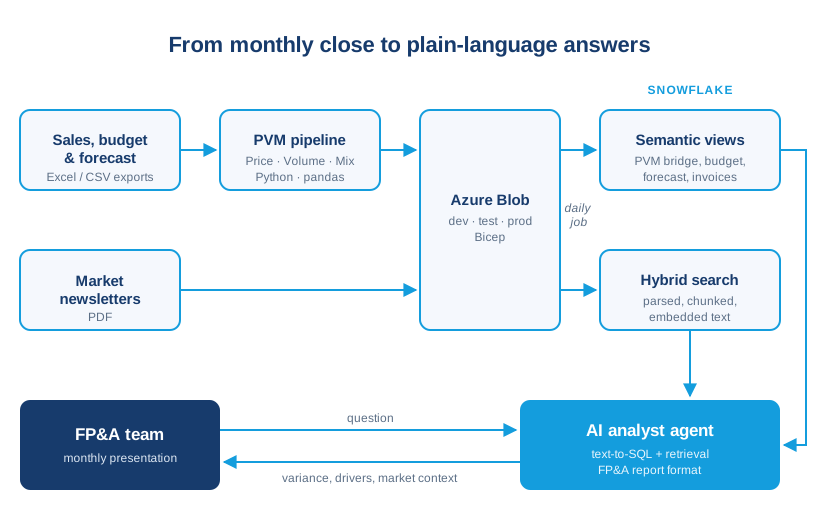
- Data: a Python pipeline computes the PVM bridge from hundreds of thousands of invoice lines plus budget and forecast. A daily job loads it into Snowflake, across separate dev, test and prod environments on Azure.
- Agent: a Snowflake Cortex Agent queries the numbers through text-to-SQL, and searches industry newsletters for the reasons behind them, such as automotive demand, hide prices or tariffs.
- Analyst playbook: its instructions make it ask when the period or comparison is ambiguous, drill into the segment that explains the variance, say so when the data cannot support a confident answer, and reply in the executive format used in the monthly deck.